The ball I threw when I was playing in the park still hasn’t touched the ground.
—
Dylan Thomas
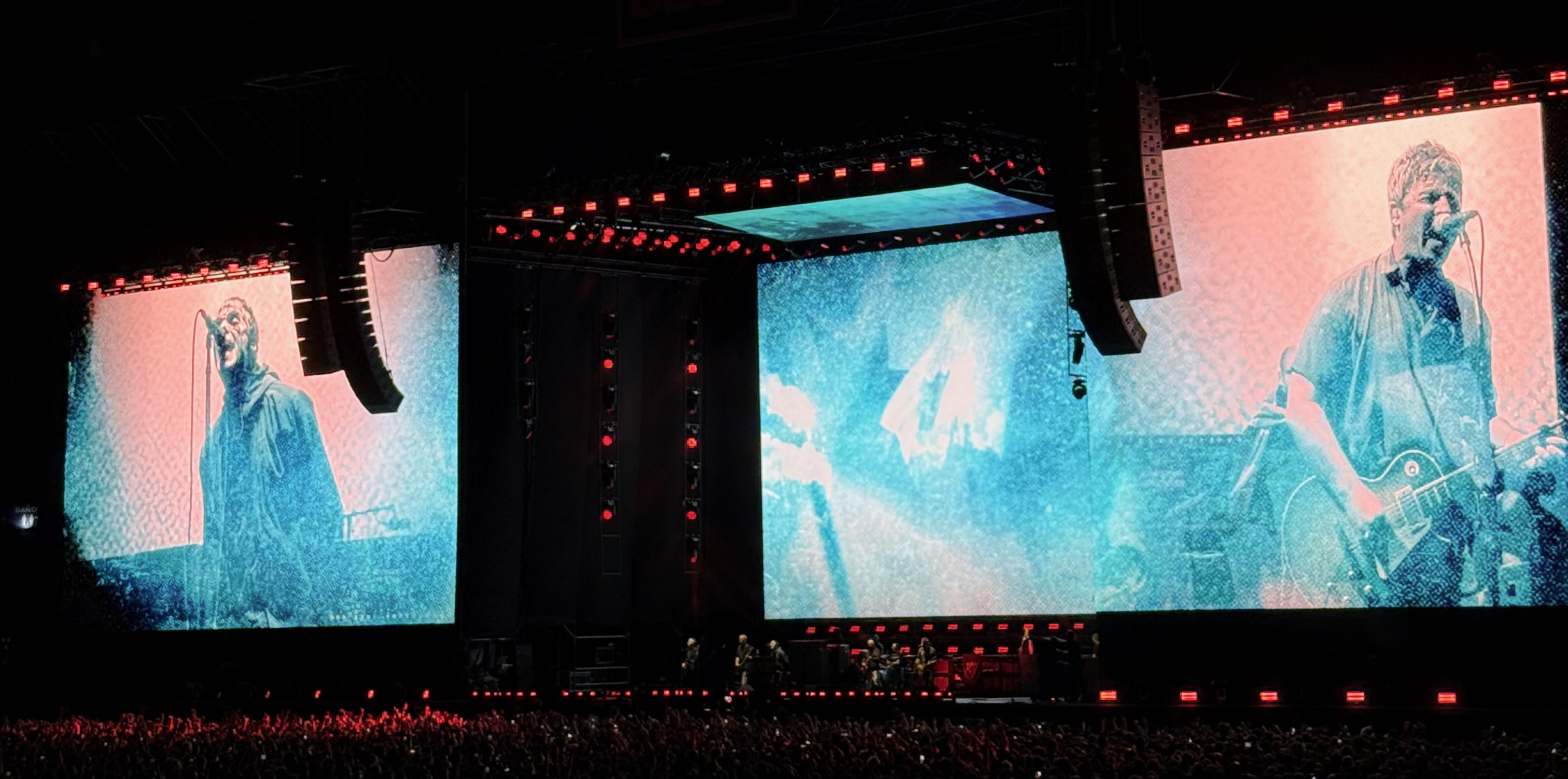
After a year of biting my nails, of battling the FOMO fueled by social media that wouldn’t stop showing videos of the brothers making gestures on stage, or of the thousands and thousands of people jumping, singing, crying in stadiums all over the world, the day finally came. The day of seeing, live, the band of my adolescence. Oasis at River Plate, 2025 tour.
I read on X a fan who wrote, after the show, that the passage of time is unfair and relentless: when milestones happen —events that turn people’s lives inside out, that shift certain foundations, certain structures— it isn’t right for everything to keep moving forward the next day as if nothing had happened. We demand a pause. Anything that has nothing to do with the event itself must stop, abruptly, to give way to a period of reflection, of processing. Because milestones leave an echo. Immediately after witnessing them, you don’t understand anything. You’re left with a bitter aftertaste you can’t explain and don’t know where it comes from. Time settles it, kneads it, ages it, turns it into something intelligible, expressible.
I came back from Buenos Aires in airplane mode. After the concert, a sadness took shape —a void, a contained urge to cry in the backyard of my mind that I couldn’t understand. I got home and immediately the vines of everyday responsibilities began to populate the garden of my brain. The invincible tick-tock of the clock: work with its pre-concert loose ends that were now urgent, obligations with looming deadlines for a longed-for but stressful move, pets, expenses, the general maintenance of life. The constant holding on, to keep everything from going to hell. But that back corner of the garden was asking something of me that the vines couldn’t fully silence: sit down and write, sit down and write. Try to process it, try to put into words whatever happened during those two hours of fully argentinized British rock and roll.
The following Wednesday I managed to carve out a few minutes to vomit words into my personal journal. Something came out; something got cut short. Drafts. Electric reflections, shapeless. And the vine constantly trying to knock down the door, creeping forward with lianas and leaves through the millimeters of space between frame and opening.
Today, twenty days after the event, close to the end of a year that went by like a snap of the fingers, I find myself on a plane headed to the Gallaghers’ homeland for work reasons, rethinking what happened that night. I’m moving through time zones over the Atlantic; it feels like the relationship with time is different here: it stops, it becomes a parenthesis —exactly what we were demanding. No one asks anything of you; the phone stops being a rattle. Time has a scent. You can taste the Chilean wine the flight attendants serve.
Being busy is a status symbol nowadays, they say —more than vacations, more than leisure time. Playing at being an adult, at having a thousand things to do. But that game can easily get out of hand. The seriousness of the game, especially the compulsive kind. Ten years ago, I listened to Stay Young and Live Forever until my eardrums begged for mercy. The message was clear: an ode to youth, to the immortality of new souls, untainted by the pain of the adult world. The images of all the rock and roll icons flashing through Oasis’s visuals at Maine Road ’96 —most of them died at 27; there is a club that represents them. I had a “club” with two lifelong friends, the oldest group in my WhatsApp: Artaud. We named it that because one afternoon we emptied our adolescent wallets to buy, between the three of us, the Pescado Rabioso’s disc. We always joked about the 27 Club —whether we’d make it there or not. When we finally turned 27, we celebrated. We endured life.
Today, eternal youth is romanticized; the fear of aging has become pathological: longevity hacks, collagen, the medicalization of consumption. Did Stay Young, Fade Away, and Live Forever contribute to that trend? I don’t know. I think the crux of the matter wasn’t being young forever and living to be 150 —quite the opposite. It was about living so intensely that the fire of your existence leaves an indelible mark on the memories of others. As Hunter S. Thompson said:
Life should not be a journey to the grave with the intention of arriving safely in a pretty and well-preserved body, but rather to skid in sideways, in a cloud of smoke, thoroughly used up and worn out, and loudly proclaim: Wow! What a ride!
It’s not only a status symbol, but also a sign of having some kind of direction in life. Of following a path with a convinced chest. Of being on the road, everything under control. Of distinguishing oneself from lost souls. Look, I know what I’m doing, where I’m going. I know my north. My fifteen or sixteen-year-old self, listening to Listen Up or The Masterplan on the semicircular balcony of my bedroom in my parents’ house, didn’t have that luck: the world presented itself as an accumulation of small chaos that, when stitched together, generated an even greater, superlative chaos. Everything was confusion: navigating the insecurities of first relationships, trying to understand what surrounds you, fighting ghosts, anxiety, hunger for glory, steering dreams. One could say that fifteen years later I have a more stable reality in pragmatic terms: my professional career is going well, I’m in a company and an industry where impact is plausible, there’s demand and there’s also reward. Plus, the stability of a long-term relationship gives you the chance to project into the long term, to venture and carry out decidedly adult ideas. But every time everything seems to run smoothly, without friction needing lubrication (“life is automatic”), I remember that adolescent with existential problems —undoubtedly more wounded and vulnerable to external stimuli than this 2.0 version— taking refuge from his identity crisis in an idolization of Liam’s strong personality, and I recognize a deeper truth in his condition: no matter how much the world distracts you with its fancy stuff and endlessly reinvented carrots, no matter how much experience and traveled paths dispel some fears, confusion, the certainty of being lost, and inevitable mortality are always running, relentless, in the background. And there is a certain joy, a certain freedom, in accepting that unbreakable fate. As Dylan says in Like a Rolling Stone:
When you have nothing, you have nothing to lose
(though he also said, in Tryin’ to Get to Heaven:
When you think you’ve lost everything, you find out that you can always lose a little more
—but that’s a topic for another post). Everything hangs by a thread, and in some respects that small adolescent in the throes of adolescence had it clearer, closer to the surface, than many adults running on autopilot.
Time passed, and the unpredictability of the world ended up playing in our favor. At the time, it wasn’t crazy to assign a higher probability to a meteor wiping us out like the dinosaurs than to the possibility of an Oasis reunion. I never put many chips on it —kind of pessimist by default. So that listening experience was nostalgic from the start, orphaned. The separated brothers were a bond with my sister, a shared obsession. River 2009 was experienced through a pixelated YouTube filter; Noel at Rosario’s Metropolitano and Liam at the Movistar Arena were emotional echoes but insufficient—more map than territory. Just as life can surprise you for the worse, it can also do so in the opposite direction. Who would have imagined it? Not even in the wettest dreams of that pubescent kid smoking on the balcony, staring at the stars while injecting himself with artificial ego through Supersonic or Cigarettes & Alcohol, or melancholy through the fateful MTV Unplugged. I remember having a Post-it stuck to my bedroom wall with a handwritten Melville quote:
Be true to the dreams of thy youth.
I don’t know if I followed it to the letter in every respect, but this was definitely one of them.
Oasis: an isolated place in the desert where there is water and vegetation grows. It’s night in the middle of the Atlantic Ocean; the lights are off, most passengers are asleep. The only glow is my laptop screen; the only sound, the keys being pressed. This plane is an oasis over the ocean. Just as the traveler who stumbles upon the mysterious lake must hydrate and continue on his way, in a few hours I’ll have to leave this plane and reenter, once again, the twisted pipes of everyday life. Another X user posted that he loved the “gordos Oasis”: on Monday they’d go back to being accountants, freelancers, lawyers, to having boring lives —but for one weekend they were all the same, they were all supersonic. Supersonic was the kickoff at River that called for the need for a room of one’s own, for the retrospective island.
The water of the oasis is warm; stepping in with the first foot isn’t hard.
The world can wait.
